
Oggetto: matrici inverse
Corpo del messaggio
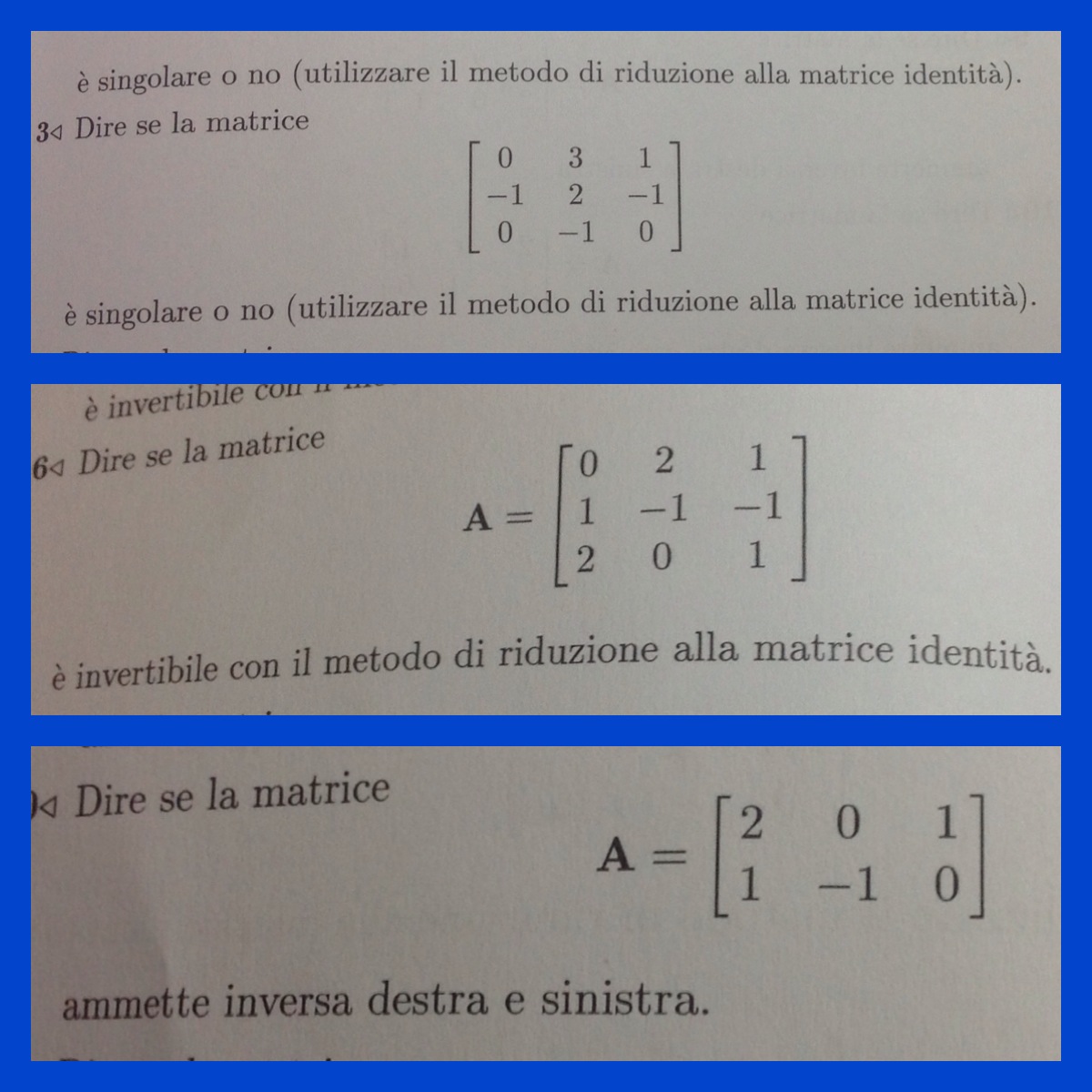
Risposta dello staff
3)
![\[\begin{bmatrix} 0 & 3 & 1 & \left | & 1 & 0 & 0 \\ -1 & 2 & -1 & \left| & 0 & 1 & 0 \\ 0 & -1 & 0 & \left| & 0 & 0 & 1\end{bmatrix}\]](https://www.matebook.it/wp-content/ql-cache/quicklatex.com-836d95dc00027b00bfb1106b709f54d6_l3.png "Rendered by QuickLaTeX.com")
Alla prima sommiamo la seconda:
![\[\begin{bmatrix} 1 & 1 & 2 & \left | & 1 & -1 & 0 \\ -1 & 2 & -1 & \left| & 0 & 1 & 0 \\ 0 & -1 & 0 & \left| & 0 & 0 & 1\end{bmatrix}\]](https://www.matebook.it/wp-content/ql-cache/quicklatex.com-acec42c43b85c4d049da4618fb349912_l3.png "Rendered by QuickLaTeX.com")
Alla seconda sommiamo la prima:
![\[\begin{bmatrix} 1 & 1 & 2 & \left | & 1 & -1 & 0 \\ 0 & 3 & 1 & \left| & 1 & 0 & 0 \\ 0 & -1 & 0 & \left| & 0 & 0 & 1\end{bmatrix}\]](https://www.matebook.it/wp-content/ql-cache/quicklatex.com-d251a0c03475e718fbb2150255b216ee_l3.png "Rendered by QuickLaTeX.com")
Moltiplichiamo 3 volte la terza e a questa sommiamo la seconda:
![\[\begin{bmatrix} 1 & 1 & 2 & \left | & 1 & -1 & 0 \\ 0 & 3 & 1 & \left| & 1 & 0 & 0 \\ 0 & 0 & 1 & \left| & 1 & 0 & 3\end{bmatrix}\]](https://www.matebook.it/wp-content/ql-cache/quicklatex.com-4697d0e6ba6a1efdb80d2ca7de812283_l3.png "Rendered by QuickLaTeX.com")
Alla seconda sottraiamo la terza
![\[\begin{bmatrix} 1 & 1 & 2 & \left | & 1 & -1 & 0 \\ 0 & 3 & 0 & \left| & 0 & 0 & -3 \\ 0 & 0 & 1 & \left| & 1 & 0 & 3\end{bmatrix}\]](https://www.matebook.it/wp-content/ql-cache/quicklatex.com-205d3402393e7fafa3d01ca6d9f4dee4_l3.png "Rendered by QuickLaTeX.com")
Dividiamo per 3 la seconda riga:
![\[\begin{bmatrix} 1 & 1 & 2 & \left | & 1 & -1 & 0 \\ 0 & 1 & 0 & \left| & 0 & 0 & -1 \\ 0 & 0 & 1 & \left| & 1 & 0 & 3\end{bmatrix}\]](https://www.matebook.it/wp-content/ql-cache/quicklatex.com-cd118cc6c0f52e7f8ed6fc5ab267a3b5_l3.png "Rendered by QuickLaTeX.com")
Alla prima sottraiamo la seconda e 2 volte la terza:
![\[\begin{bmatrix} 1 & 0 & 0 & \left | & -1 & -1 & -5 \\ 0 & 1 & 0 & \left| & 0 & 0 & -1 \\ 0 & 0 & 1 & \left| & 1 & 0 & 3\end{bmatrix}\]](https://www.matebook.it/wp-content/ql-cache/quicklatex.com-eb229f2eac5b085c6f7023e810469f78_l3.png "Rendered by QuickLaTeX.com")
Essendoci matrice inversa, allora questa non è singolare.
6)
![\[\begin{bmatrix} 0 & 2 & 1 & \left | & 1 & 0 & 0 \\ 1 & -1 & -1 & \left| & 0 & 1 & 0 \\ 2 & 0 & 1 & \left| & 0 & 0 & 1\end{bmatrix}\]](https://www.matebook.it/wp-content/ql-cache/quicklatex.com-e4744a3053a82db58d748c8498877ab3_l3.png "Rendered by QuickLaTeX.com")
Sommando alla prima la terza, e sottraend la seconda alla terza otteniamo:
![\[\begin{bmatrix} 2 & 2 & 0 & \left | & 1 & 0 & 1 \\ 1 & -1 & -1 & \left| & 0 & 1 & 0 \\ 1 & 1 & 0 & \left| & 0 & -1 & 1\end{bmatrix}\]](https://www.matebook.it/wp-content/ql-cache/quicklatex.com-01459033374425a612bb8faa1c7d9b74_l3.png "Rendered by QuickLaTeX.com")
Essendo prima e terza riga multiple l’una dell’altra, allora questa matrice non è invertibile.
9)
La matrice non ammette inversa a sinistra perchè:
![\[\begin{bmatrix} a & b \\ c & d \\ e & f \end{bmatrix} \cdot \begin{bmatrix} 2 & 0 & 1 \\ 1 & -1 & 0 \end{bmatrix}=\begin{bmatrix} 1 & 0 & 0 \\ 0 & 1 & 0 \\ 0 & 0 & 1 \end{bmatrix}\]](https://www.matebook.it/wp-content/ql-cache/quicklatex.com-056f7e8dec94ddf9fe4b1ec02ff6c825_l3.png "Rendered by QuickLaTeX.com")
avrà nello stesso sistema:
![\[\begin{cases} 2a+b=1 \\ -b=0 \\ a=0 \end{cases}\]](https://www.matebook.it/wp-content/ql-cache/quicklatex.com-ecdae357325b18f93cff73d0e2c957fb_l3.png "Rendered by QuickLaTeX.com")
che è impossibile.
Ammetterà invece inversa a destra poichè:
![\[\begin{bmatrix} 2 & 0 & 1 \\ 1 & -1 & 0 \end{bmatrix} \cdot \begin{bmatrix} a & b \\ c & d \\ e & f \end{bmatrix}=\begin{bmatrix} 1 & 0 \\ 0 & 1 \end{bmatrix}\]](https://www.matebook.it/wp-content/ql-cache/quicklatex.com-554338a47f502825e01926c429d39a9a_l3.png "Rendered by QuickLaTeX.com")
avrà nel sistema:
![\[\begin{cases} 2a+e=1 \\ 2b+f=0 \\ a-c=0 \\ b-d=1 \end{cases}\]](https://www.matebook.it/wp-content/ql-cache/quicklatex.com-27bf6441e430de81e6c6ff385e11d1be_l3.png "Rendered by QuickLaTeX.com")
che ammetterà infinite soluzioni del tipo:
![\[\begin{bmatrix} a & b \\ a & b+1 \\ 1-2a & -2b \end{bmatrix}\]](https://www.matebook.it/wp-content/ql-cache/quicklatex.com-3928d6cbbbd9bb611129dd80590778ae_l3.png "Rendered by QuickLaTeX.com")
Sostituendo ad a e b valore nullo, otterremo una inversa:
![\[\begin{bmatrix} 0 & 0 \\ 0 & 1 \\ 1 & 0 \end{bmatrix}\]](https://www.matebook.it/wp-content/ql-cache/quicklatex.com-c914dc9fc08530fa1a54b024c1b0c0bf_l3.png "Rendered by QuickLaTeX.com")
(Questa pagina è stata visualizzata da 447 persone)